Last week, I had the privilege of delivering the Lectio Magistralis for the graduating Doctors in Philosophy at the University of Bergamo. The ceremony, presided over by Rector Prof. Sergio Cavalieri, was held in the magnificent Aula Magna—once the 13th-century Church of Sant’Agostino, now a place where history and scholarship meet.
In my lecture, “The Life You Design,” I reflected on the journey of a PhD as more than the pursuit of knowledge—it is training for resilience, creativity, and courage in the face of uncertainty. I encouraged graduates to see their lives as evolving prototypes: to embrace experimentation, to redefine success on their own terms, to find strength in diversity, and to design futures that respond to the world’s most pressing challenges.
I left them with five design rules:
* Begin with intention, not certainty.
* Experiment, learn, and adjust.
* Redefine success in your own terms.
* Pay attention to what others overlook.
* Leave room for imperfection and surprise.
Now, these new Doctors step into the world not as passengers, but as designers—ready to ask questions others fear to ask, and to shape the future with imagination and integrity.
Publication: Architectural swarms for responsive façades and creative expression
Living architectures, like beehives and ant bridges, adapt to their environments through self-organization of swarming agents. Most human-made architectures are static, and can’t adapt to changing conditions.
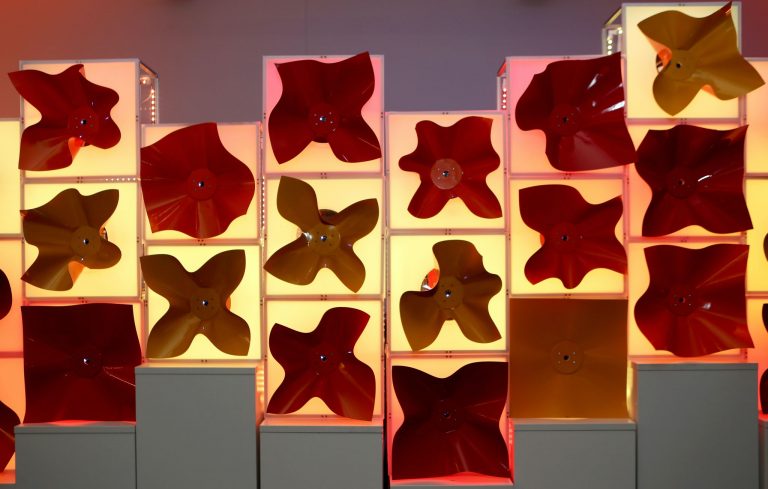
That’s why Princeton engineers designed the Swarm Garden, a modular architectural facade that integrates swarm intelligence and robotics. Each module, resembling flowers, uses buckling sheet technology to open and close in response to environmental stimuli.
A paper published in Science Robotics demonstrates two applications. In one study, the team applied a Swarm Garden prototype to an office window to illustrate adaptive shading, where the robotic flowers open and close in response to sunlight. The second study explored creative expressions in interior design where the robotic flowers responded to human interaction during a public exhibition.
M. Alhafnawi, J. Bendarkawi, Y. Tafesse, L. Stein-Montalvo, A. Jones, V. Chow, S. Adriaenssens, R. Nagpal. (2026) ‘Architectural swarms for responsive façades and creative expression.’ Science Robotics, DOI: 10.1126/scirobotics.ady7233