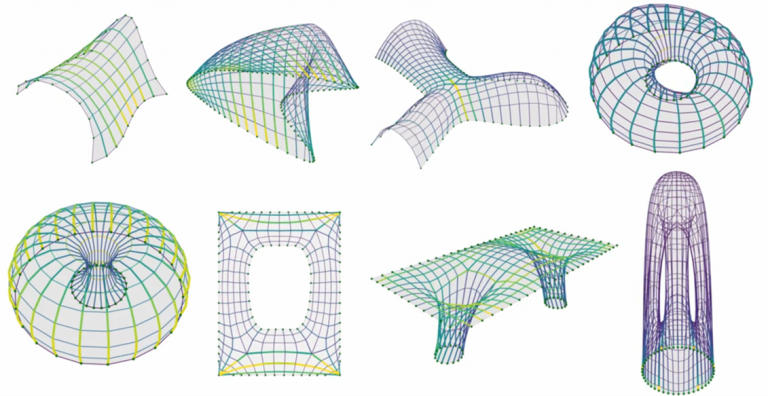
The differentiable force density method (DFDM) for lightweight structural design has been published in Computer Methods in Applied Mechanics and Engineering.
📝 Paper (open-access): https://lnkd.in/eKK6XQKD
👾 Python + JAX code: https://lnkd.in/ezuaiRCC
This paper demonstrates how to merge structural mechanics models and differentiable programming for fast shape optimization of structures modeled as pin-jointed bar systems.
The work is comprehensive: it constructs the FDM from first principles using an energy-based standpoint, its nonlinear generalization to 3D to handle shape-dependent and follower loads, and later exposes the gradient-based optimization approach with custom adjoint rules that the DFDM enables for solving inverse problems in structural form-finding.
The DFDM supports flexible design parametrizations for general design constraints within one differentiable framework: force-density optimization, load-finding, and support-finding. We demonstrate this versatility on high-dimensional examples, including shape fitting, pneumatic cable-length control, gridshell planarization with reaction-force minimization, and masonry retrofitting via external post-tensioning.
A major part of the work is validation for speed and correctness. We benchmark the DFDM against analytical and numerical references, study CPU/GPU scaling, and use Taylor remainder tests to verify the accuracy of the hybrid gradient computation. We also include a minimal reproducible implementation where the core logic fits in just 50 lines of Python!
For the structural mechanics community, the message is that automatic differentiation and analytical derivatives work best in tandem – together, they can produce faster and more stable gradients for nonlinear structural optimization. Our mathematical framework can be extended to other structural simulations, particularly for broader finite element models that require iterative solvers, like Newton-Rapshon, for simulation.
For machine learning, the DFDM enables the native integration of analytical mechanical models into neural networks to build trustworthy surrogates for structural optimization that produce accurate solutions in real-time while fully respecting mechanics laws, rather than as a soft penalty.
R. Pastrana,K.U. Bletzinger, D. Oktay, R.P. Adams, S. Adriaenssens (2025) ‘Differentiable force density methodDesigning lightweight structures with differentiable force density method.’ Computer Methods in Applied Mechanics and Engineering.