© All Rights Reserved.

Form Finding Lab.
Princeton University

Journal Publication: Integration of Kinks and Creases Enables Tunable Folding in Meta-ribbons

You can read about our important work on the mechanics of kinks and creases now in Matter. Free downloads here

https://lnkd.in/eNu48a5G


Highlights

The nonlinear folding behaviors of annular ribbons are comprehensively investigated
•The folding mechanism and bifurcation type of elastic annular ribbons are uncovered
•The meta-ribbon is created by integrating in-plane kinks and out-of-plane creases
•The tunable dynamic folding behavior of a meta-ribbon is achieved

Progress and potential

Exploring how thin structures fold can lead to innovative technologies in fields like soft robotics, flexible electronics, and space deployable systems. By studying the mechanics of folding in elastic ribbons, through discrete model, theory, and experiment, we uncovered that different types of folds, i.e., in-plane kinks and out-of-plane creases, initiate folding in distinct ways and correspond to different types of bifurcation. We also found that by combining these folds strategically, we can create “meta-ribbons,” which can fold smoothly or abruptly based on how they are engineered. This tunability opens doors for advantages like controllable dynamic folding and transitions among different stable states, offering exciting possibilities for future technologies. 
More insights

Publication: Digital guidework for augmented thin-tile vaulting construction

Masonry vaults are among the most elegant and efficient structural forms, yet their construction has long been slowed down by costly falsework and guidework.
Our team explored a new path: augmented reality as digital guidework. Instead of rigid scaffolding, masons can now follow holographic projections that provide just the right amount of visual support—keeping builders in control of their analog craft.
In field tests, this approach improved productivity by ~30% while achieving remarkable accuracy (within 1% of the vault span). Looking ahead, interactive mixed-reality could further boost precision, speed, and even training opportunities.
This work shows how centuries-old craftsmanship and cutting-edge technology can merge to keep masonry vaulting not just viable, but visionary. Read more about our findings here https://lnkd.in/d4-KcCxS

Read more >

Publication: Design of purely compressive shells under vertical and horizontal loads through Machine Learning-driven form-finding

We are excited to share our latest research on advancing the design of shell structures under challenging loading conditions. Traditionally, form-finding methods for masonry vaults focus on vertical loads, but extreme wind or seismic forces introduce significant design and safety complexities.
Our new paper explores an alternative to computationally intensive optimisation steps in Membrane Equilibrium Analysis. Using machine learning regression techniques—XGBoost, Random Forests, and k-Nearest Neighbours—we identify optimal Airy Stress Function parameters to improve efficiency and maintain structural integrity.
Case study results show that these methods can reduce computational demands while achieving material-efficient designs, with k-Nearest Neighbours delivering the best performance in our tests.
Read more about our findings here: https://lnkd.in/eEnu8sEW

Read more >

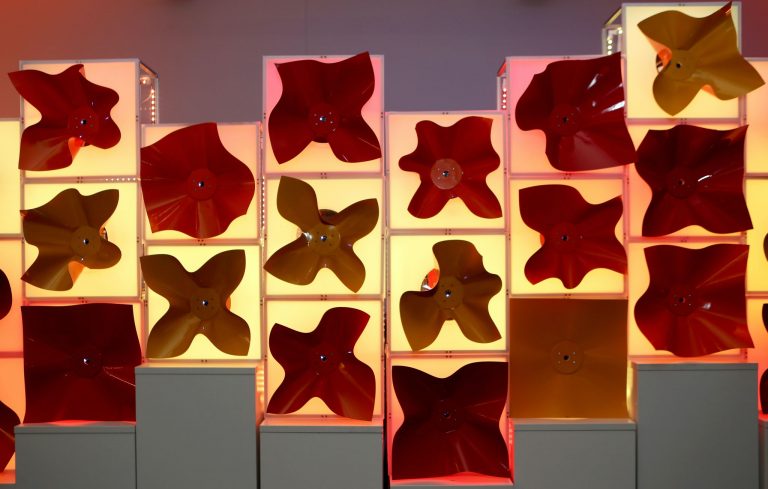
Exhibit: Alternative Skies at the Venice Architecture Biennale, Italy

We’re pleased to share that our latest paper, “Numerical modeling of cantilevered bigon arm mechanics under gravity,” by Axel Larsson @axla.io and Sigrid Adriaenssens is now published Open Access in the Journal of the Mechanics and Physics of Solids (link in bio)

In this work, we investigate the stability regimes of reconfigurable bigon arms under gravitational loading—offering new insights into multi-stable structural systems.

Read more >